Industrial networks are shifting from Gigabit to 10 Gigabit Ethernet as IT and OT converge onto the same backbone. But faster links don't automatically mean safer ones: as more traffic rides on fewer, higher-capacity connections, the cost of losing even a single link rises. The fundamental design question shifts from available bandwidth to pricing redundancy against the cost of a failure.
Redefining Acceptable Risk at 10 Gbps
The promise of IT/OT convergence is operational synergy, but the reality is a complex balancing act of constraints. Industrial backbones are now tasked with carrying heavy traffic—like visual inspection video—alongside OT control signals. To handle this, networks are migrating to high-capacity shared links. However, consolidating traffic onto fewer, faster pipes fundamentally changes the math on failure. Traditionally, a 0.1% packet loss rate on a 100 Mbps link would have resulted in a loss of 8 packets per second—potentially masked by TCP retransmission. At 10 Gbps, the same 0.1% adds up to roughly 800 dropped packets every second. In the 10 Gbps age, the traditional 0.1% rate becomes untenable for sensitive systems. As backbones scale up, industries need a new calculus and new risk management tools.
Matching Redundancy to Risk
True resilience isn't built on a single technology. While ring topologies form the baseline of industrial redundancy, their limitation emerges during a failure. When a severed link forces the ring to heal, traffic is rerouted across surviving nodes—a sudden shift that can easily bottleneck the network under heavy load. To build depth into the architecture, networks can overlay these rings with high-capacity trunks, absorbing link failures locally before the ring is forced to reconverge. Depending on the specific operational risk, two mechanisms are available:
- Standard Link Trunking. Bundles multiple physical ports into a single logical channel, delivering massive aggregate bandwidth and basic link-level fault tolerance. However, because trunking distributes traffic using a hash algorithm, a link failure can cause uneven redistribution across the surviving ports. If a constituent link overloads, packets drop and disrupt critical operations—despite apparently ample aggregate bandwidth.
- Reserved Backup Trunking (High Availability). Integrates dedicated standby links into the trunk architecture. When an active member fails, a standby immediately takes its place, keeping the number of active paths unchanged and traffic distribution stable to prevent packet loss. However, this stability requires dedicating physical ports that will not carry everyday traffic. The hardware trade-off makes it a strategic choice: best deployed at the core layer, in safety-related monitoring, or wherever a millisecond of downtime carries a genuinely high cost.
Calibrate Your Strategy
Network design is ultimately an exercise in risk management. The optimal architecture balances hardware expense, future growth, and the true cost of downtime. Consider the following:
Port economics. True High Availability requires reserving backup capacity. Port reservation for hot stand-by is an opportunity cost—reserved ports are not available for ordinary traffic or expansion. To calibrate the decision, consider your baseline: An upgrade from legacy 1GbE links to a well-designed 10GbE trunk represents a major reliability and bandwidth upgrade, and may be a reasonable stopping point.
Scalability without disruption. Ring and chain topologies, including ring coupling, allow the network to grow incrementally without taking the whole system offline. For infrastructure with minimal or non-existent maintenance windows, this architectural flexibility matters as much as raw bandwidth.
Downtime impact. A standard failover completes in milliseconds. The greater risk emerges in the aftermath: if the surviving links lack the headroom for redirected traffic, congestion causes sustained packet loss long after the failure is technically "handled". For supervisory control of moving assets, safety-related monitoring, or a core layer where multiple streams converge, this degraded state carries real operational consequences. In these high-consequence cases, reserved backup capacity ensures traffic lands on a dedicated path, paying for itself the first time a link fails.
Real-world Execution
Real-world constraints guide architecture choices. Here is how these redundancy mechanisms deliver reliability for high-stakes rail operations:
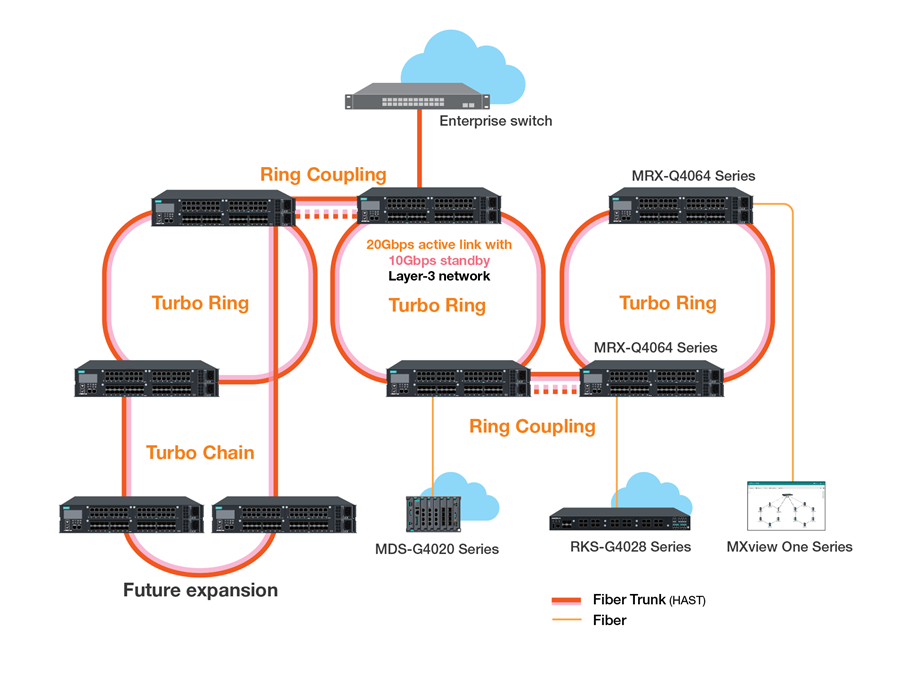
- Trackside supervisory network: A rail operator upgrading to a 20Gbps backbone combined coupled ring and chain topologies with a hot-standby 10GbE trunk. This architecture quadrupled previous bandwidth and secured headroom for future expansion. Thanks to this modular design, the operator successfully added extended services like passenger information and ticketing without disturbing active operations.
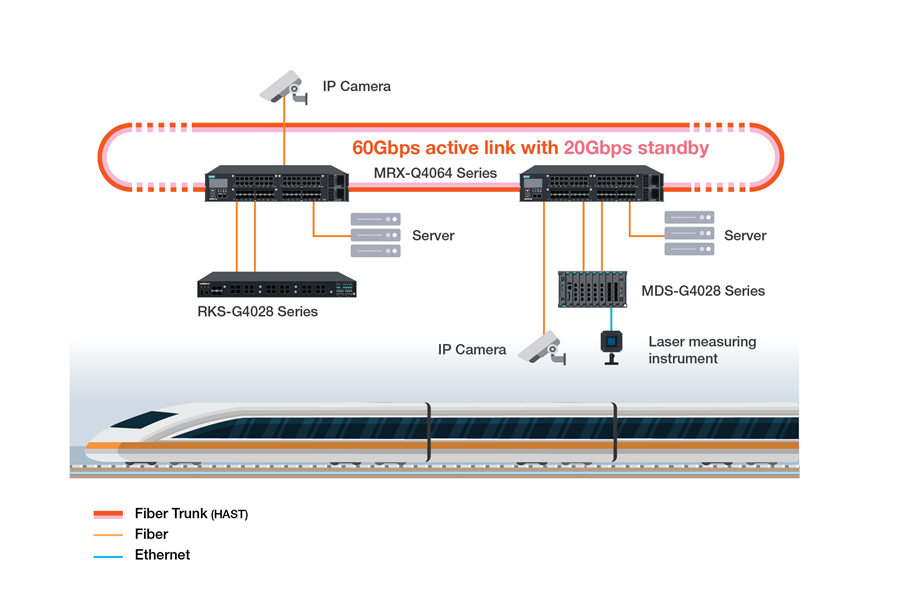
- Onboard rail inspection vehicles: Rail inspection vehicles present severe physical constraints: dense HD cameras, laser instruments, and servers packed into tight, front-wired, vibration-heavy cabinets. By replacing multiple 1GbE connections with high-density 10GbE links, the operator built a trunk delivering 60Gbps of active capacity and 20Gbps of reserved backup. This architecture drastically reduced the switch count, simplifying cabling and minimizing physical failure points while securing high-capacity reliability.
Built for Exactly This
Meeting the demands of IT/OT convergence requires hardware engineered for the realities of a multi-tiered strategy. The Moxa MRX-G4064/Q4064 Series provides this intentional foundation. Featuring high-density 1GbE downlinks (upgradable to 2.5GbE) and multiple 10GbE uplinks, it delivers the physical capacity to scale from the edge to the core. However, raw bandwidth does not solve the failure calculus. To protect downtime-sensitive segments, the MRX Series leverages Moxa’s High-Availability Static Trunk (HAST) technology. By keeping traffic distribution stable during a link failure, HAST provides the critical mechanism needed to protect against hidden packet loss on the backbone. Backed by EN 50121-4 rail certification, the platform aligns physical capacity with intelligent redundancy—delivering exactly what high-stakes operations require. As industrial backbones evolve, the calculus of network reliability will only grow more complex. For deeper insights into managing IT/OT convergence and architecting resilient infrastructure, explore Moxa's Futureproof Industrial Network Solutions.